
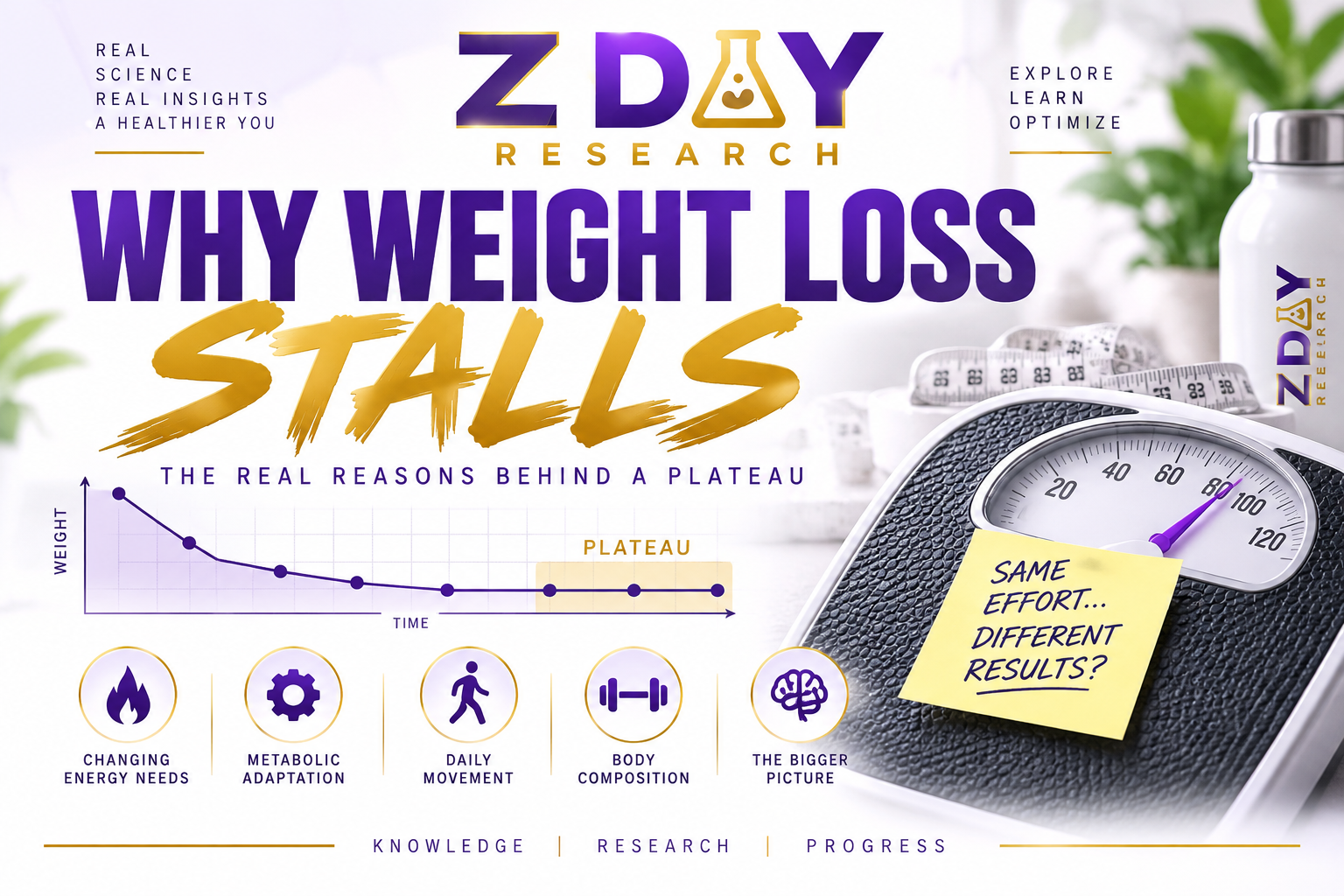
The Scale Stopped Moving… But You’re Still Not Hungry? 🤔
Your appetite is still controlled. You’re eating less than you used to. Everything seems to be going right…
But suddenly the scale isn’t moving.
So what gives?
A weight-loss plateau doesn’t necessarily mean appetite suppression has stopped working. As body weight decreases, the body’s energy needs can change too.
Here are a few reasons why. 💜💛
1. A Smaller Body Needs Less Energy 🔥
Think about carrying a 40-pound backpack everywhere you go. Moving around requires more energy with it than without it.
Weight loss works similarly.
As you become lighter, your body generally requires fewer calories to maintain and move itself.
That means the same food intake that created a large calorie deficit months ago may eventually create a much smaller one.
Same intake. Smaller body. Different energy equation.
2. Your Body Can Become More Energy-Efficient 🧠
You’ve probably heard people say their metabolism went into “starvation mode.”
That’s an oversimplification.
Researchers use the term adaptive thermogenesis for changes in energy expenditure that can occur during weight loss.
Research suggests this effect varies considerably between people and may sometimes be fairly small.
Your metabolism isn’t necessarily “broken.” Your body is simply adapting to a different body weight and energy environment.
3. You May Be Moving Less Without Realizing It 🚶
Workouts aren’t the only movement that burns energy.
Walking around the house, standing, cleaning, taking stairs and even fidgeting all contribute to something researchers call NEAT — Non-Exercise Activity Thermogenesis.
During weight loss, some people unconsciously begin moving less throughout the day.
You might still hit the gym exactly like before while burning fewer calories during the other 23 hours.
Those little movements add up.
4. Appetite Suppression ≠ Guaranteed Fat Loss 🍽️
Appetite suppression can make eating less much easier.
But hunger doesn’t determine how many calories your body burns.
As your energy requirements decrease, the gap between calories coming in and calories going out can become smaller.
Eventually:
Energy In ≈ Energy Out
And the scale can stabilize — even while appetite remains well controlled.
Don’t Panic Over a Few Flat Weigh-Ins ⚖️
Water, sodium, carbohydrates, digestion, exercise and other factors can move body weight around from day to day.
A few days without weight loss isn’t necessarily a true plateau.
Look at the trend over several weeks, not one morning on the scale.
And remember that the scale isn’t everything. Resistance training and adequate protein can be especially important during weight loss because preserving lean mass matters too. 💪
The Z Day Takeaway 💜💛
Weight loss isn’t perfectly linear.
As your body gets smaller, energy requirements change. Daily movement can change. Your body can adapt. And normal water fluctuations can temporarily hide progress.
So if appetite suppression remains strong but the scale slows down, it doesn’t automatically mean something stopped working.
Sometimes the equation simply changed.
Follow the trend. Protect lean mass. Stay active. Keep learning. 🔬
Research References
• Martins et al. — Weight Loss Plateau: Reasons, Challenges, and Solutions (2026)
• Nunes et al. — Does adaptive thermogenesis occur after weight loss in adults? A systematic review
• Binmahfoz et al. — Effect of resistance exercise during dietary weight loss: systematic review and meta-analysis (2025)
For research and educational purposes only. Not medical advice.