
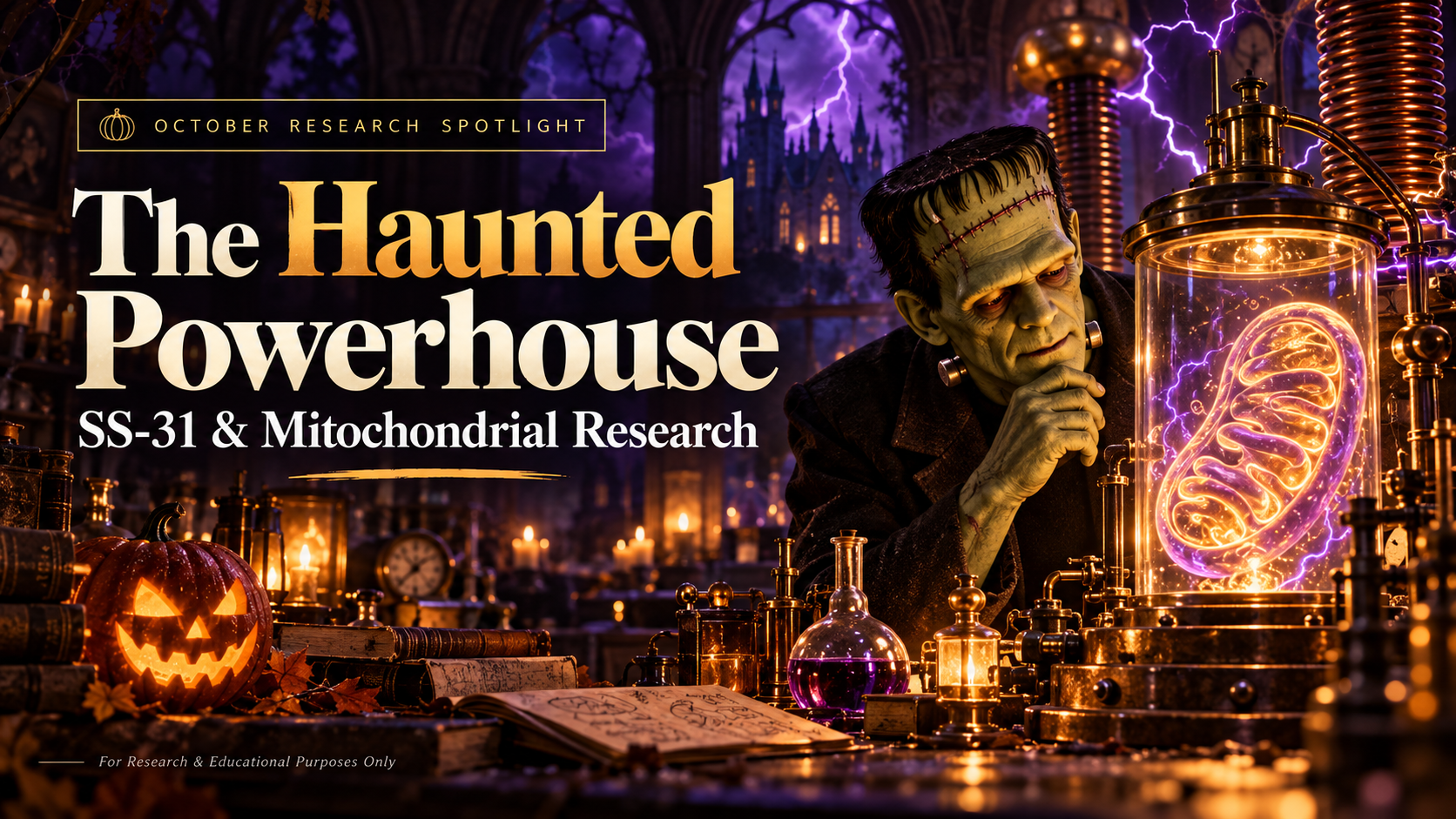
👻 The Haunted Powerhouse Every cell needs energy to function, and much of that energy comes from the mitochondria. These tiny cellular “power plants” help produce ATP — the main energy currency used by cells. But when mitochondrial structure or function is disrupted, energy production can become less efficient and oxidative stress can increase. That is one reason mitochondrial research has become such a major area of interest.
⚡ Enter SS-31 SS-31, also known as elamipretide, is a small mitochondria-targeting peptide. Researchers are especially interested in SS-31 because it appears to interact with cardiolipin, a specialized lipid found in the inner mitochondrial membrane. Cardiolipin helps support the structure of mitochondrial cristae and the machinery involved in energy production. Research suggests SS-31 may help stabilize this environment and support mitochondrial bioenergetics.
🧪 What Are Researchers Looking At? SS-31 research has focused on areas such as: Mitochondrial structure ATP production Oxidative stress Cellular energy metabolism Mitochondrial dysfunction Much of the research has been preclinical, while clinical studies have also explored elamipretide in several conditions involving mitochondrial dysfunction.
🧟 SS-31 vs. MOTS-C SS-31 and MOTS-C are both connected to mitochondrial research, but they are not the same thing. MOTS-C is a mitochondria-derived peptide involved in metabolic signaling. SS-31 is studied more for its direct interaction with the inner mitochondrial membrane and cardiolipin. Different pathways — same spooky cellular neighborhood. 👻
🎃 Trick or Truth? Trick: “SS-31 is basically just another form of NAD+.” Truth: They are studied in very different ways. NAD+ is a coenzyme involved in cellular metabolism and redox reactions, while SS-31 is a peptide being studied for its interaction with mitochondrial membranes and bioenergetics. So while both show up in cellular-energy research, they are not interchangeable.
For Research & Educational Purposes Only This article discusses scientific research for general education and does not provide medical advice. SS-31/elamipretide remains an investigational compound.